Showing posts with label europe. Show all posts

Monday, November 29, 2010

Thanksgiving, Extended Edition


The wonderfully welcomed view that we woke up to on Thanksgiving morning
I heard that Wellsboro woke up to the same view, it made me feel closer to home which is also a good thing on Thanksgiving day. 


 Thanksgiving Day, American-style fun at GTL


Full on tackle football
Thankfully it was too muddy and slippery for many big hits, mostly people were just sliding into each other and the snow and mud made for a softer landing. 
I can't wait to do that laundry!


I was unaware that Michael had been home until I walked into the bathroom to find this. He was kind enough to rinse it all out and hang it to dry at least.


 We enjoyed an excellent, as usual, meal at GTL complete with plenty of turkey, stuffing, mashed potatoes and sweet potatoes along with many, many interesting dishes from any number of cuisines. After dinner was the "talent" segment. The blurry picture above is of Katrina and Jessie (hope I'm spelling that right) during their "GTL Ballad: 21 going on 22". It was a hysterical re-mix of the ever popular "16 going on 17" from the The Sound of Music that confronted the trials and tribulations of being a GTL scholar. 

After their little ditty...we performed. Well, not Michael and I; any of you that know Michael know that he wouldn't be caught dead on a stage performing. No, the day before the dinner our friend Peter asked me if I would be willing to do a song with him and I agreed...reluctantly. We practiced all that afternoon and ran through the song a few times with the mic that day. I would be lying if I didn't tell you that I was incredibly nervous, but that's what happens when you haven't been on a stage in nearly 7 years I suppose. I'm even nervous about posting this...my hands are sweating. But, here you have it. Peter and I singing "Baby, It's Cold Outside".


Oh, and if anyone with any power at GTL is reading this, please do not hold the performance portion after dinner, I thought I was going to explode. Oh, and a big thanks to Michael for putting up with hearing this song on constant repeat for 24 hours and for recording the song.


On Saturday we got a little out of order (you'll see why later); we made ourselves some yummy eggnog (for the record, eggnog with cognac=amazing!) and lit up our little palm tree thing.


Since we'll be leaving in a mere 2.5 weeks, it'll have to suffice until we can get home to enjoy our parents' full-sized Christmas trees.  


We struggled for a long time that night to come up with something to make for dinner. We ended up settling on an epicurious recipe for Veal Cacciatore mainly because we have a lot of polenta in our pantry to use up in the next few weeks. On top of everything else, I feel like our time in France has opened up my eyes to new meats that I never really considered eating in the states and veal is certainly at the top. Veal has always had a bad rep in the stated because of some particular farms that were confining and abusing the animals and the market has never really returned. Here in Europe however, people care about their food in a way I have never seen before (OK, the Culinary Institute of America did have a high respect for food). There are very strict regulations in place for animal treatment and food safety and everywhere you look, there are these incredible looking, incredible tasting meats readily available in the supermarket (rabbit, quail, guinea fowl, lamb, veal, horse even?) and you know that it didn't live in the horrible conditions that we see in US factory farms. Sorry to get up on my soapbox but in short, if you have access to humanely kept veal, it is a delicious, lean, and tender meat, and it was oh so yummy in this particular dish.

Despite our wonderful Thanksgiving meal at GTL, I felt that I had missed out. I missed stuffing myself with stuffing and potatoes and lots of gravy. I missed the leftovers. So, Michael being the wonderful husband that he is, agreed to help me make a second Thanksgiving feast just for the two of us. 

And because there was only two of us, and because I frequent the food section of the New York Times all too often, we decided to try a new turkey breast method and recipe. The turkey breast is first brined overnight then it is tightly wrapped in seran wrap and tin foil before being effectively steamed in a low oven until the internal temperature is 135°.


I can't even being to describe how strange the turkey breast looked and felt after coming out of the oven. 


Seriously, it was gross!
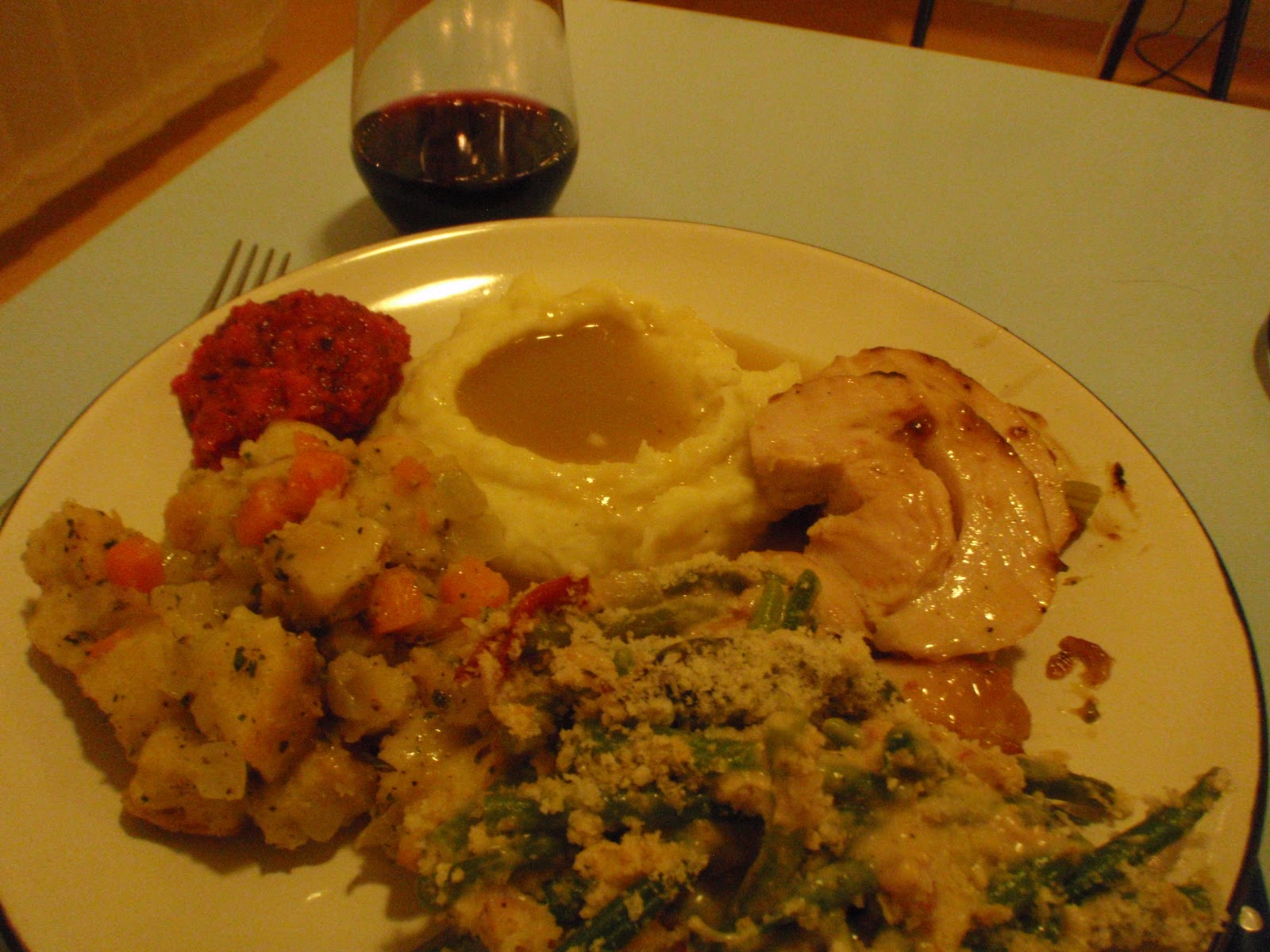

The turkey turned out to be delicious although we weren't too sure about the honey and roasted garlic glaze that went on at the very end, it never really set and although it tasted delicious it was just kind of slimey. On the whole though, we loved the steaming  method and plan to use it again but perhaps with a different glaze at the end.

The meal was rounded out with a green bean casserole and stuffing (both from The Pioneer Woman blog, her food always looks amazing), basic mashed potatoes, gravy and my family's uncooked cranberry relish kicked up a notch (1 bag cranberries, 1 entire orange (skin and all), 1-1" piece of ginger and 3/4 c sugar blended in the food processor until finely chopped). Oh, and we drank one last bottle of Beaujolais Nouveau for the year with the meal. Really, everything turned out perfectly and even though we've done our first "married" Thanksgivings at GTL, it was really nice to have a night and the dinner just to ourselves.

Less than 3 weeks people...!

Thursday, November 18, 2010

Vogler Parents' Visit: The Loire Valley

Monday: the scenic route (a.k.a.-avoiding tolls)


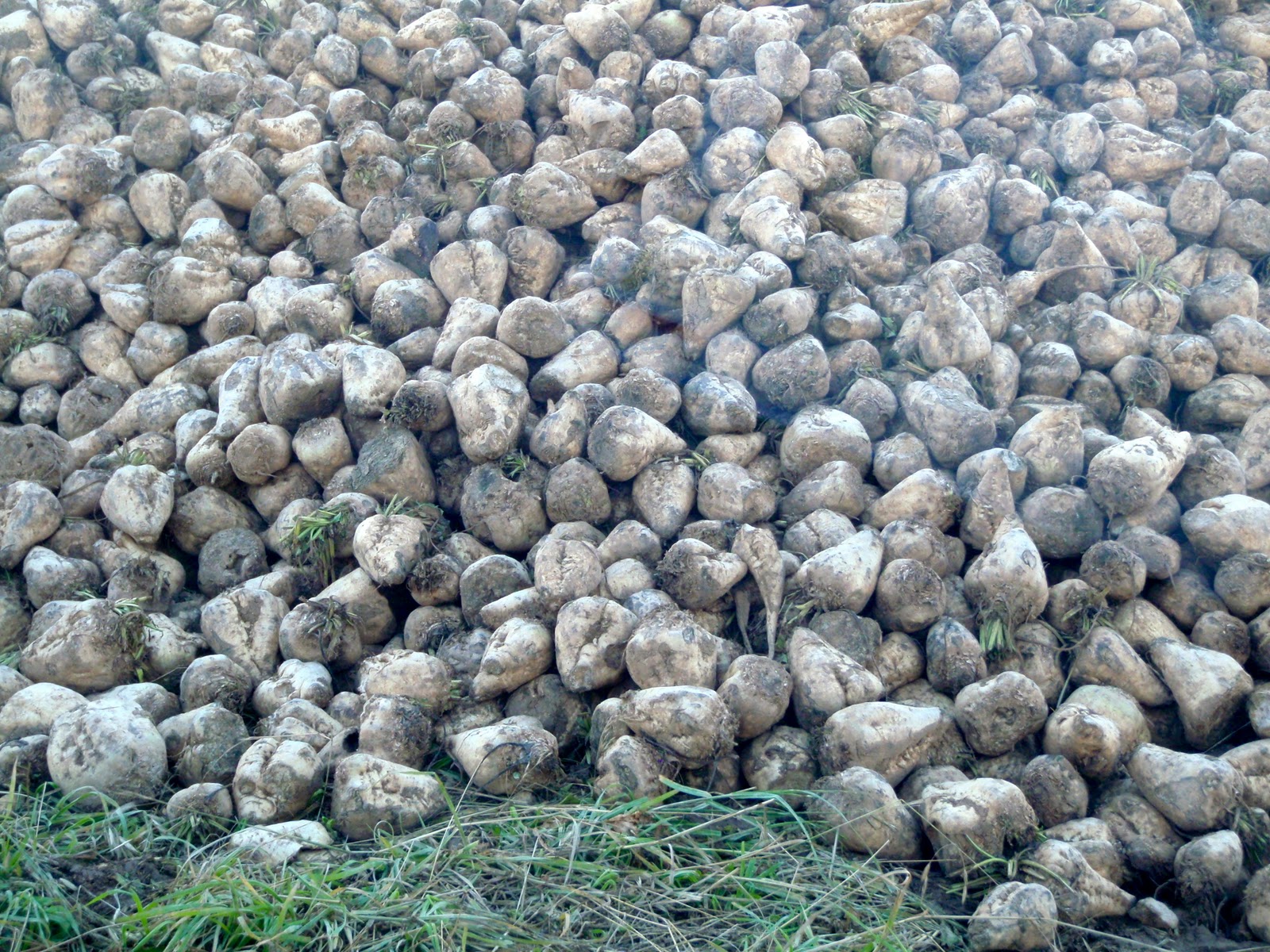
We came across hundreds of piles of these mysterious root vegetable on the "scenic route". What could it be? First we thought potatoes, then maybe parsnips, then it was celery root...


Until we saw large piles of them in front of this factory


In front of this sugar factory. The mysterious piles on the main [non-toll] route from Metz to Paris are sugar beets.


We arrived that night in Blois (pronounced: bla) and came across this majestic beauty while on a "night" walk (since dark comes at 5:00 already, not that I'm complaining Alaskerella!). 


Tuesday: the Loire Valley


On Tuesday morning we walked around Blois in amazement at the trees that were probably there before the Revolution.


Then we went to check out this hunting lodge. No, really. Château de Chambord was built as a hunting lodge by François I.


And because it was made as a temporary royal residence, everything was collapsible


 And beautiful.


The roof even looked like it's own city.


Dad and his baguettes, he just couldn't get enough. 


That night we walked around the picturesque town of Amboise and at dinner at the delicious L'Alliance.


Wednesday: we woke up


To these outside our B&B window. The chickens made all kinds of noise when our host, Alex went out to swipe eggs for our breakfast.


On to another Château with a tree lined drive. Excuse me while I suppress my wishful thinking...


Interesting Fact #1: This one (Château du Chenonceau) made history when in 1547, it was given by Henry II to his mistress, Diane de Poitiers. At Henry's death, his wife, Catherine de' Medici reclaimed Chenonceau and forced Diane to move on to a lesser Château. (I love that story)


Interesting Fact #2: During the Revolution, while the revolutionaries were destroying all that related to power and religion, the owners filled the chapel with firewood, tricking the revolutionaries into believing that the room was just storage.


We got to see the kitchen in this Château and being a cooking family, we were all intrigued and perhaps imagining taking some things home. 


For example: Michael wanted to take this hand-cranked rotisserie (a form of punishment for our future children?) but instead, had me take many, many pictures so he can one day replicate it. 


I wanted to take home the stove but didn't think it would fit in the Twingo.


Did I mention that this Château was built over the river?


I think I also forgot to mention the labyrinth


Where you can pick escargot.


After another yummy picnic lunch we went to the Marc Brédif wine caves to sample the wine and walk though part of the 2km long storage caves.


For dinner that night we went to the beautiful town of Loche. While working up (walking up) an appetite we came across the Château de Loches, particularly it's defensive buildings.


After dinner we headed back to the B&B (here's our room, by the way) for a rousing game of hearts and a good night's sleep.


Thursday: 


We played with the resident donkey before packing up and 


 Taking the Twingo to Versailles,


 Which was oddly filled with Japanese art (but still beautiful).


Postcard reads: "Greetings from Versailles!"

Wednesday, October 27, 2010

Field Trip #4: le Centre Pompidou

In it's heyday (if the term "heyday" can even stretch for almost 2000 years) Metz was a very important city. It is located smack-dab in the middle of Europe at, like Pittsburgh, the confluence of two rivers making it both a strong hold both in trade and military. But also like Pittsburgh, as the end of the industrial time ended, the lull began and it has been a bit of a struggle to keep the city relevant, at least to non-messins (people from Metz).

Enter the Centre Pompidou - Metz, our new branch of the famous Parisien modern art museum which was completed and opened this past May. The idea behind this museum branch (and the corresponding TGV (high speed) train line directly from Paris to Metz) was and is to bring more notice and more traffic to the area; to bring back to life what was once a bustling and popular city, which we are all for. As if I haven't mentioned enough in this blog what a fantastically overlooked area of France we live in and our fingers are crossed that the Centre Pompidou-Metz is just it needs to spring up from the metaphorical ashes.


Here it is in all of it's Chinese hat styled glory. The building was designed as a team effort by Shigeru Ban (Japanese) and Jean de Gastines (French).


In all the roof line is made up of 16 kilometers of laminated timber covered by a thin fiberglass layer which has been coated in Teflon.

Our wonderful (partially pictured) English speaking tour guide along with our French teacher Madame Serafin gave a wonderful tour of the facility.

The window provides an optical illusion making the cathedral seem much closer than it is in reality.

This was one of my favorites, it feels like you are looking through fog (or like I couldn't hold the camera still).

On this floor of the museum one wall held the masterpieces while the opposing wall displayed the "making of the masterpiece utilizing photos and even videos of the artists whilst at work.

A room of Laurel leaves

The enormity of some of the pieces was obviously striking; notice Michael looking up in the bottom right hand corner.

Such a well designed museum -- even the hallways become art. I am in the center-left of the photo looking up at the mirrors on the ceiling.


In conclusion: come, visit.
If you are ever in Paris, certainly check out the Centre Pompidou (which we still need to see). But if you have extra time in Paris, take the 1.5 hour high speed train to Metz. Visit the town. Visit the Museum. You won't be sorry. (Especially if you are under 26, which means you are admitted into the museum for free!)

Monday, October 18, 2010

what to write & Field Trip # 4: Fort de Queuleu

I never considered myself much of a writer. I've never before experienced writer's block. I suppose there is a first time for everything. I've wanted to write this past week but could never bring myself to. I also had the duel problem of not being able to get Michael off of his computer and not being able to pull myself away from knitting Michael's sweater/watching an embarrassing tv show; the two activities are one to me and they tend to become addictive. But Michael is in class now and then he will be working on research until our afternoon class and I have already watched 3 embarrassing episodes today and am 2/5 of the way down Michael's sweater's sleeve. I think it's time to write.

___________________________________________________________________________________

Fort de Queuleu


You may vaguely remember Fort de Queuleu from this earlier post. Can I just interrupt myself right here and  say that those old blog posts embarrassing -- not that I've ever been confident in writing. Anyway, reading that old post I can't help but remember how strange it seemed to me that such a seemingly historically significant place, an interrogation camp where the Nazis held prisoners just down the road from our dorms, be turned into a fitness course. At the time, over a year ago, it seemed almost blasphemous to hide the story of the fort in that way. Looking back over our time here though, my feelings on the subject have softened. I still can't say I'm completely comfortable running a lap or two around the camp (not that I could run that far if I tried) but I think I get it in some vague way.

Part of the problem is funding; money's always a problem though, right? Everywhere you look, every corner you turn there is another WWII site, another Roman ruin. We don't have the problem to such an extent in the US because of our comparatively shorter and less....extensive history, but with so many historical sites, funding will eventually run out and only so many places will be preserved.

The other problem is the memory, the memory of a scarred region. In many ways, I get the feeling that people want to forget. They want to forget that once again, France collapsed under the pressure of Germany.  They don't want to think about the people tortured and killed right across the street from their house. And that feeling is completely understandable. But some wanted, some needed to remember. And the volunteers that are now running the association that keeps the fort up and safe (and doing so for free, taking care of the funding issue) are those that needed to remember because you see, the association was formed by those who lived through the terror of imprisonment at Fort de Queuleu, they lived through the interrogation, were sent to a concentration camp and lived to return. They needed to remember because they couldn't forget. Their families and friends have carried on the memory after them.

As I mentioned before, the construction of Fort de Queuleu began 1867 when the Minister of War acquired 4 pieces of land surrounding Metz in order to build fortifications around the city in anticipation of the war with Prussia that was seeming more and more likely. Construction was continued by the French up until Metz was annexed by Prussia (Germany) during the Franco-Prussian war in 1870. The treaty of Frankfurt made Metz a Germany city in 1871 and construction of the fort was continued by the Germans from that time on. They named the fort Goeben after the Prussian general who was best known for winning the battle of Spicheren, the first victory of the Prussian army over the Moselle region (our region). In 1918 France re-entered Metz and after the treaty of Versailles in 1919, Metz was officially returned to France. For the most part, the fort lay dormant until WWII.

In 1943 Metz was once again Annexed by Germany and fort de Queuleu was turned into a top secret interrogation camp where members of the French resistance (including active rebels such as Joseph Derhan, those French people who simply didn't want to be forced to speak German and everyone in between) were tortured and interrogated before being sent to a concentration camp (most often to Natzweiler-Struthof, which was the only concentration camp within France's borders). It is thought that 1500-1800 people went through the camp, 36 were killed and 4 escaped through a ventilation shaft before American troops began to advance on Metz in 1944 at which time the prisoners were forced to march to the concentration camp. Those interned there called it "Hell of Queuleu" (Enfer de Queuleu).

SS Sonderlager feste Goben, Fort de Queuleu casemate "A" camp de concentration 1943-1944

The Entrance

Never That or Never Again or just Never


"c'est en ce lieu que 1800 patriotes ont ete veux bandes pieds et mains lies durant des jourd des semaines des mois assis sans bouger sans parler maintenus en prevention avant d'etre transferes dans les camps de concentration     
                   
ici point de chambre a gaz de crematoire un hauptscharfukrer hempen commandant ce lieu suffisait condamne a mort par le tribunal militaire de metz le 10.4.51 pour le meurtre de 36 patrioted on le retrouvera plus tard officier de police a Oldenbourg R.F.A."

after very very rough translation:

"it was here that 1800 Patriots were kept with eyes, feet and hands bound for days weeks months left alone without moving or speaking before being transferred to concentration camps
here no gas chamber of crematorium hauptscharfukrer a hempen (something German, couldn't translate) this place's  commander was sentenced to death by a military court in Metz on 4/10/1951 for the murder of 36 patriotes he was later found, the police officer Oldenburg Germany"
Prisoners were forced to stand with their arms raised for hours before being given their number (in German) which they had to remember lest they be beaten.
The interrogation room
A solitary confinement room for the "really bad" ones
The normal chamber. The prisoners were made to sit with blindfolds on these benches with their backs straight against the bed for hours every day.
Where 4 managed to escape; the last remaining of these 4 men passed away just last year.
The prisoners were bathed here by having buckets of freezing cold water thrown on them. The only bathed once when they arrived and never after, some going almost a year in without washing int he same clothes they were brought in.
Where they used the bathroom, it was right in the middle of the communal bedroom.