For a more detailed photographic tour of Prague, click
HERE to view the accompanying photo album.
After our delicious sausages in Dresden we set off on our train to Prague. As it turns out, the river that we took so many pictures of in Dresden winds through the countryside, meets up with some other rivers, and eventually becomes the
Vltava river in Prague. Because of this, the train ride down to Prague was absolutely beautiful. The weather was still as cloudy and rainy as it had been up until that point in the trip but the combination of the gray fall clouds, the brightly colored fall foliage and the vibrant green of the grass was enough to keep me happy. This was my second trip to Prague; Hamilton Gibson children's choir (for those of you not from Wellsboro, HG is a community theater and choir group) did a tour of Prague and the Czech countryside back in 2003 that my mom and I went on. We had an incredible time in Prague back then so I was very anxious to get back and show Michael how wonderful the city is.
We came into the north station of town which was a part of the city that I don't remember ever visiting in '03. The streets and even the train station showed the telltale signs of years under communist rule with the massive concrete buildings, dilapidated streets, graffiti everywhere and vacant lots overgrown with weeds and junk. We again had a bit of a hard time finding a detailed enough map to find our hostel but we eventually bought one from the tourist information office and made our way through more dilapidated, vacant streets to our hostel which happened to be very close by. The hostel was still in that very depressing neighborhood but as we neared the hostel (and neared the downtown area) attempts at improvements became more and more apparent. You could see where nicer, older styled architecture apartment building were being put in the vacant lots between the 1970's era concrete block buildings, which cheered me up a bit. The hostel itself was very nice and even had a fully equipped kitchen which to took advantage of while we stayed by buying breakfast supplies at a near by grocery store, saving us quite a bit of money! After getting some pointers from the receptionist we started what would become our twice daily 2 mile walk into and out of the city, which was not the prettiest of walks. The picture below was one of our first views of the river.

We made our way, winding through the streets until we finally came up on Old Town Square which is the home of the Tyn Cathedral (shown below), Old Town Hall, and the Astronomical Clock which is also known as the Praha Orloj (originally built in 1410).

"The Orloj is composed of three main components: the astronomical dial, representing the position of the
Sun and
Moon in the sky and displaying various astronomical details; "The Walk of the Apostles", a clockwork hourly show of figures of the
Apostles and other moving sculptures; and a calendar dial with medallions representing the months." (taken from the wikipedia article on the Orloj). People start to gather in front of the clock at about 20 'till every hour to get a good spot for the moving spectacle. We happened to arrive at the square just a few minutes before the hour so we witnessed the moving of the clock ourselves before walking and exploring the streets of Old Town Prague by night. For dinner that night we decided to get some traditional Czech food which translates into: we decided to each eat a fist-sized rock. It's not that Czech food isn't good, it's just insanely hearty and heavy. I had a rich beef stew with the traditional and very dense boiled bread dumplings; the only veggies on the plate were the 3 or 4 slices of cooked onion in the stew. Michael managed to go a little (but not much) lighter with a spatzle, pork and saurkraut dish. We both enjoyed some cheap but good Czech beer to go along with the meal. Everything was tasty, but not amazing, although the final bill was something like $12 for the two of us (even after being scammed out of $2 with a 28% "tax") so we weren't complaining.
Day #2 in Prague we ventured to the other side of the river and explored the Senate building, Prague Castle, and St Vitus Cathedral (which is surrounded by the Castle).

My memory may be skewed but because of the sudden jump in tourism, what was a dirt-cheap city when I visited 7 years ago seems to have gone up quite a bit in price. I don't remember tours being quite so pricey back when we were there with HG and since we were working a pretty small budget on this trip,
we didn't opt to tour any of the buildings. We did walk through the streets and royal gardens (where we took the photo below) and since the Cathedral was free, we went in, admired everything, and took some pictures.

In the afternoon we hiked up to the next hill over to see the The Petřínská rozhledna (Petřín lookout tower) which was modeled after the Eiffel tower but is much smaller (only 60m high as opposed to la Tour Eiffel at 324m), however, since it is situated on top of a large hill, the tip of the tower is at the
same elevation as the Eiffel tower.

We hiked around the hill a bit more and found an obscure statue of Mary with an incredible vista of the city, then headed down to the the Strahov Monastery for dinner and more beer which served as another flashback from my trip in 2003 when we sang at a Sunday mass in this very Monestary. Obviously we had to practice in the Monestary the day before and while there, we realized that they had a brewery within the Monestary which we thought was pretty interesting. Most of our group of friends were 16 or 17 during the trip but the drinking age in Czech Republic is 15 so that night a big group of us and our parents made a trip back to the Monestary for some late night drinks. Needless to say, it was pretty novel as a 16 year old to be able to legally drink with your parents, at least for us Americans. The Monastery was a wonderful memory from that original trip and I was very happy to have found it again and to be able to return for dinner. The beers were wonderful, and for a little less than $2 for a glass, they were well worth the price. For dinner Michael had chicken roasted in beer with braised red cabbage and bread dumplings while I had a crispy trout with fried onions and herbed potatoes; while still being traditionally Czech, this meal was much lighter and tastier than our first meal here.
Day #3 in Prague was spent mainly in the downtown or Old Town area of Prague. We wandered over to Wenceslas square where we admired, yet again, the sudden boom in tourism and consumerism in Prague. The photo below is the statue on the square of St. Wenceslas.

Then as a contrast, we walked up to the Jewish area to see the old Synagogue, the beautiful architecture and the Jewish Cemetery which is so old (and so small, I guess) that is consists of 12 layers of graves.

We also walked over the Charles Bridge where we saw the exact vendor that I bought an orange barret from back in 2003. We wandered a bit on the other side of the river and eventually found what I was looking for, the Lennon wall, once a normal city wall that was converted into a peaceful wall covered in Beatles inspired graffiti. It was a constant source of irritation to the communist regime in the late 1980's, repeatedly the wall was painted over only to have the graffiti reappear overnight.

The wall looks nothing like it did just 7 years ago but since much of this trip was focused on the atrocities of the communist rule in this part of Europe, I was happy to re-visit this ever-changing memorial to peace.

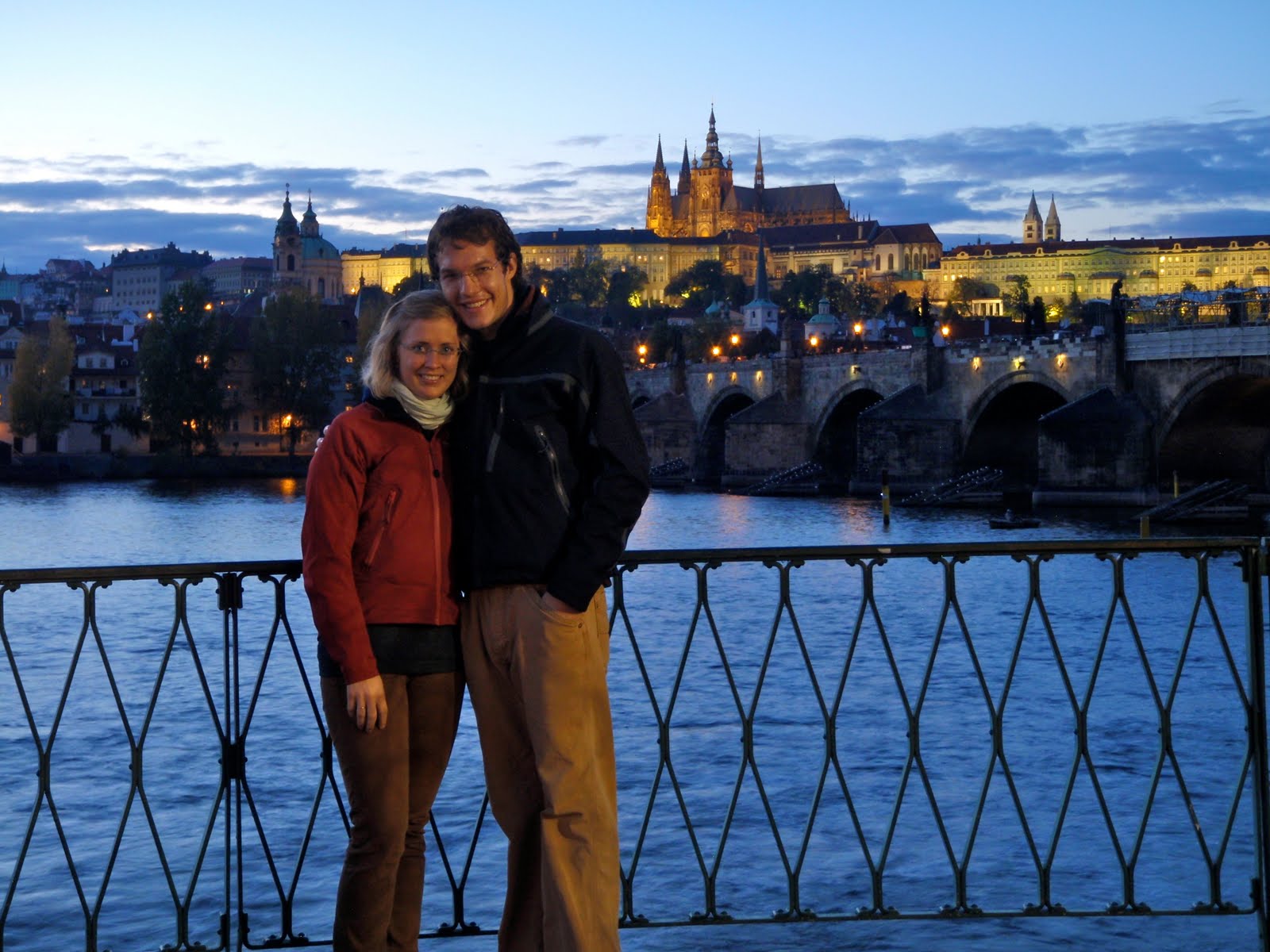
After exploring the bridge and taking some pretty twilight time pictures of the bridge and castle, Michael was determined to buy a little bottle of absinthe as a souvenir so we went from store to store until we found a bottle of Czech absinthe (which is pretty gross, for the record). And after a yummy pizza dinner and one more night in our awesome hostel, we hopped on another train on our way to Belgium.
 The photo above is of the Berlin central train station which is currently the largest train station in all of Europe and also the only train station in Europe to have train tracks running into it at right angles. You enter on the ground floor, which is a shopping area. The next floor down (below ground level) is a shopping area. The bottom floor, which is two floors below ground level is one of the train platforms. Then, above the ground floor is another train platform floor (it was creepy to have the trains going over you in a mainly glass building) where the trains run perpendicular to those on the bottom train level. It was in this train station that we arrived after the long train journey back along the river, through Dresden again then up to Berlin. We had roughly 24 hours in Berlin before we planned to catch our next train up to Copenhagen. Because of this I was worried that we wouldn't get much out of our time in Berlin. Thankfully I was proven wrong. In Dresden and Prague tours and admission prices were pretty exorbitant so if you wanted to learn the history of the city, you either had to pay top dollar for it then or do as we did and read all about the place in Wikipedia after coming home; at times I'm convinced that Michael is having an affair with Wikipedia, he will sit down and read for days on end after a trip -- which I've decided is probably a good thing after we've spent many days in much closer proximity to each other than is normal in this tiny apartment, but I digress. Berlin, unlike those cities, makes all of it's history very prominent and public. Our first night there, we spent a good 2 hours (freezing) reading walls with hundreds of posters documenting the rise and fall of Hitler and the subsequent rise and fall of the Soviet occupation of the city and country.
 The Rick Steves Europe 2009 clued us into the fact that there are many companies that organize free walking tours of Berlin so after a Dunkin' Donuts breakfast (pictured above) we took full advantage of that little tip. If you are ever visiting Berlin, I urge you to find one of these tours. The guides work for tips (and are very animated and interesting because of this) and give you a very comprehensive 3-ish hour tour. I'm going to give you a brief overview of the main sites we visited while in Berlin both on our own that first night and with the tour guide the next day.
 The first stop on our walking tour was of the Brandenberg Gate located on Pariser Platz. It was formerly one of many gates around the city and is now the only one remaining. Located to the left of this picture is the ugly bunker-style American embassy and to the right is the doubly ugly French embassy...the pictures aren't worth posting here.
 The newly finished (2005) Memorial to the Murdered Jews of Europe was next on our tour. The memorial was meant to be indivually interpreted by each visiter but at the same time, was meant to cause a feeling of confusion and unease. This picture was taken at the very edge of the memorial but as you can see in the distance, the paths between the concrete slabs dip down and the slabs get higher and highter. By the time we got to the middle, we 10 feet below street level with 20 ft of concrete towering over us. We heard somewhere (either Rick Steves or our tour guide) of a scandal when the memorial was getting it's final touches. It was found that the company hired to cover the slabs with a graffiti resistant glaze had been a major producer of the deadly gasses used to exterminate people in the concentration camps during the war. This lead to a lengthy and heated moral debate within the board of trustees but in the end they decided that they can't continue to shun everyone who wasn't on the right side of the war; not to mention the fact that many slabs were already coated in the glaze and would have to be destroyed and rebuilt if they voted against the company which would have cost many millions more. In the end, the concrete slabs were glazed for free by the company.
 The parking lot pictured above doesn't look like much but was actually very important. While standing on this lot we were actually standing over the bunker where Hitler and his wife famously killed himself just before the soviets succeeded in taking Berlin.
 This was the first view that we had of a remaining section of the Berlin wall. We were shocked at how thin it was but were later told that this was one of two walls that made up the border and the dangerous part was the space in between where guards and menacing dogs kept watch.
 This is another daytime view of this section of wall. It is fenced in and will eventually be a part of a Museum exhibit. Most of the wall was destroyed by the people of Berlin just after the collapse but they managed to save a few small sections.
 Through the city, the former path of the wall is marked out in these double cobblestones.
 Very few buildings were left standing after WWII but those that did remain still bear the marks today.
 Checkpoint Charlie was the only wall crossing checkpoint where allied forces and foreigners were allowed to cross the border between East and West Berlin. The poster in the photo shows an American soldier.
 This mural was painted as a piece of socialist propaganda to show the German people just how well socialism works and how good life can be under a socialist government.
 This mural was placed on the ground just in front of the mural above after the Soviet occupation to illustrate how bad the lives of the people actually were under the socialist government.